Category: Uncategorized

  • Birds and the ways they use a landscape

    Birds are animals characterised by feathers, and their variety can be seen in nearly every kind of landscape. Many are capable of flight, but flight is not a feature shared in the same way by every species. Size, body shape, beak form, and behaviour differ greatly. These differences reflect the many ways birds obtain food, move, reproduce, and respond to the conditions around them.

    Feathers serve more than one purpose. They help form the surfaces used in flight, contribute to insulation, and can be important in display or concealment. Different parts of a bird’s body carry feathers with different structures and functions. The visible colour also depends on the species and stage of life. A bird seen at one time of year may not have exactly the same appearance at another time.

    Beaks and feet offer clues about how a bird lives. A shape useful for taking seeds can differ from one suited to probing mud or catching moving prey. Feet can support walking, swimming, climbing, or grasping. These features are informative without providing a complete explanation by themselves. Watching how the bird actually uses them adds context that cannot always be gained from a still image.

    Birds move through landscapes in search of suitable conditions. Some remain within a relatively small area, while others make long seasonal journeys. Food, nesting places, shelter, and changing weather can all influence movement. A garden, riverbank, or patch of woodland may therefore be used differently at different times. Even a brief stop can connect a small local place with a much wider pattern of travel.

    Observation becomes more useful when it includes behaviour as well as appearance. The way a bird walks, feeds, calls, or interacts with others can distinguish it from a similar-looking species. Repeated visits to the same location reveal changes in activity and presence. Birds provide an accessible way to notice the structure of a landscape, because their daily movements show how water, vegetation, open ground, and human-made features offer different opportunities.

  • Whales: Giants of the Ocean


    Whales: Giants of the Ocean

    Whales are among the largest and most remarkable animals on Earth. These marine mammals live in oceans around the world, from warm tropical waters to the cold seas surrounding the poles.

    Life Beneath the Surface

    Although whales spend their lives in water, they breathe air through blowholes located on top of their heads. They must regularly return to the surface to breathe before diving again in search of food or traveling through the ocean.

    Whales are warm-blooded, give birth to live young, and nurse their calves with milk. A thick layer of fat called blubber helps protect them from cold water and stores energy during long migrations.

    Two Main Groups

    Whales are generally divided into baleen whales and toothed whales. Baleen whales filter small animals from the water using flexible plates inside their mouths. This group includes blue whales, humpback whales, and gray whales.

    Toothed whales use teeth to catch fish, squid, and other prey. Many of them also use echolocation, producing sounds and listening for returning echoes to understand their surroundings. Sperm whales, belugas, and orcas belong to this group.

    The Blue Whale

    The blue whale is the largest known animal to have ever lived. An adult can grow longer than a city bus and weigh well over one hundred tonnes. Despite its enormous size, it feeds mainly on tiny crustaceans called krill.

    Communication and Migration

    Whales communicate using clicks, whistles, pulses, and complex songs. Some sounds can travel across great distances underwater. Humpback whales are especially famous for their long, patterned songs.

    Many species migrate thousands of kilometres each year. They often feed in cold, nutrient-rich waters before traveling to warmer regions where they mate and give birth.

    Protecting Whales

    Commercial hunting once caused severe declines in many whale populations. Today, whales also face threats from fishing gear, ship collisions, underwater noise, pollution, and changes to ocean ecosystems.

    Conservation programs, safer fishing practices, protected habitats, and international cooperation can help whale populations recover. Protecting whales also supports healthier oceans because these animals play an important role in marine food webs and nutrient cycles.

  • Whales: Giants of the Ocean

    Whales: Giants of the Ocean

    Whales are among the largest and most remarkable animals on Earth. These marine mammals live in oceans around the world, from warm tropical waters to the cold seas surrounding the poles.

    Life Beneath the Surface

    Although whales spend their lives in water, they breathe air through blowholes located on top of their heads. They must regularly return to the surface to breathe before diving again in search of food or traveling through the ocean.

    Whales are warm-blooded, give birth to live young, and nurse their calves with milk. A thick layer of fat called blubber helps protect them from cold water and stores energy during long migrations.

    Two Main Groups

    Whales are generally divided into baleen whales and toothed whales. Baleen whales filter small animals from the water using flexible plates inside their mouths. This group includes blue whales, humpback whales, and gray whales.

    Toothed whales use teeth to catch fish, squid, and other prey. Many of them also use echolocation, producing sounds and listening for returning echoes to understand their surroundings. Sperm whales, belugas, and orcas belong to this group.

    The Blue Whale

    The blue whale is the largest known animal to have ever lived. An adult can grow longer than a city bus and weigh well over one hundred tonnes. Despite its enormous size, it feeds mainly on tiny crustaceans called krill.

    Communication and Migration

    Whales communicate using clicks, whistles, pulses, and complex songs. Some sounds can travel across great distances underwater. Humpback whales are especially famous for their long, patterned songs.

    Many species migrate thousands of kilometres each year. They often feed in cold, nutrient-rich waters before traveling to warmer regions where they mate and give birth.

    Protecting Whales

    Commercial hunting once caused severe declines in many whale populations. Today, whales also face threats from fishing gear, ship collisions, underwater noise, pollution, and changes to ocean ecosystems.

    Conservation programs, safer fishing practices, protected habitats, and international cooperation can help whale populations recover. Protecting whales also supports healthier oceans because these animals play an important role in marine food webs and nutrient cycles.

  • He Travelled 700 Km to Say Thank You: How Avasar Helped a Young Earner Build His Life

    He Travelled 700 Km to Say Thank You: How Avasar Helped a Young Earner Build His Life

    Noida, India: Avasar, Sometimes, the impact of a platform is best measured not in dashboards or growth charts, but in the people who show up at your door.

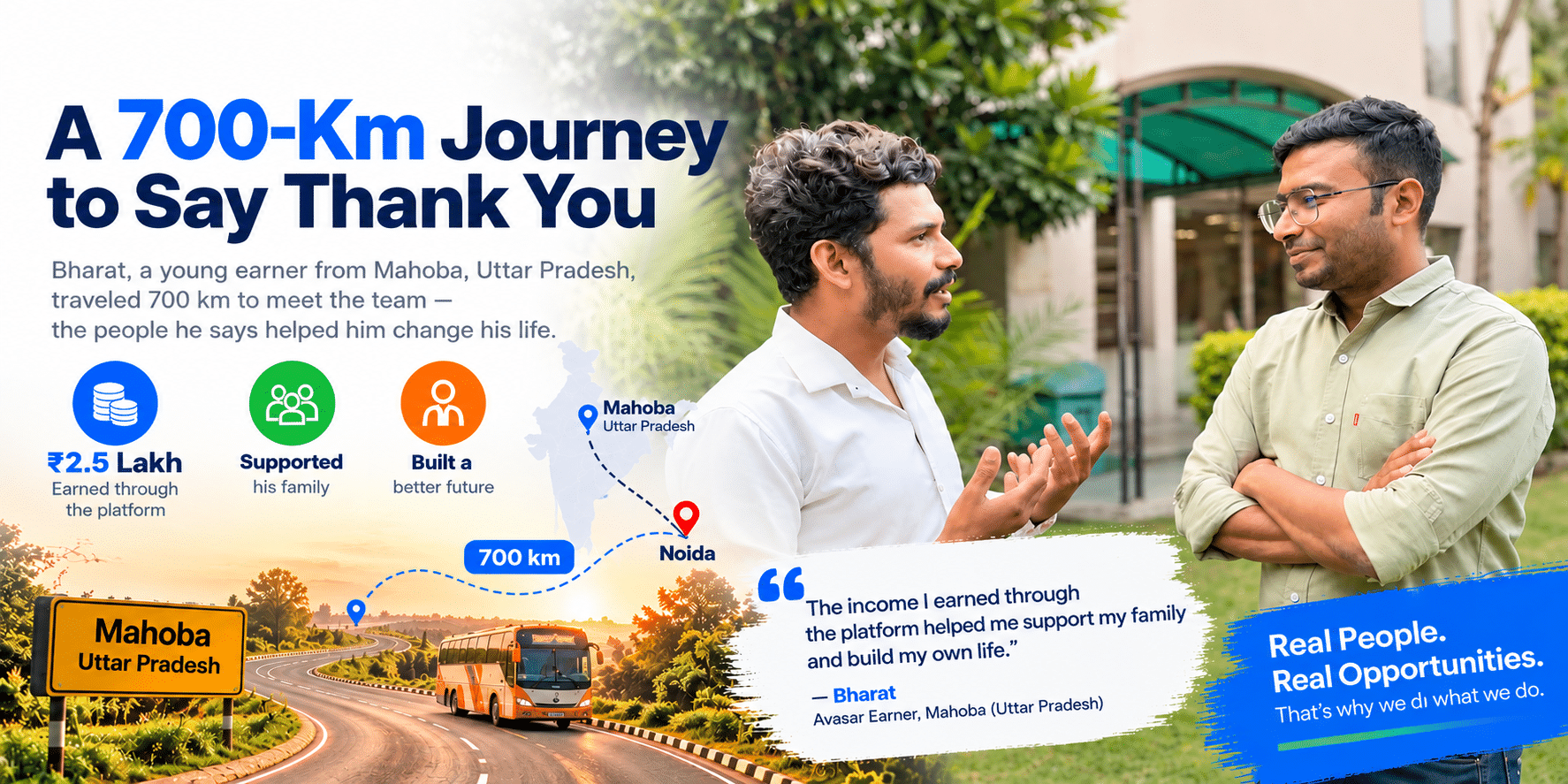
    That is what happened recently at Avasar, when Bharat, a young member of its earning ecosystem from Mahoba, Uttar Pradesh, unexpectedly walked into the company’s office after travelling nearly 700 kilometres.

    Avasar had not invited him. There was no scheduled meeting.

    Bharat simply wanted to meet the people behind the platform-the people he had spoken with during his journey and whom he credits with helping him change his life.

    Bharat began using Avasar when he was around 18–19 years old. Since then, he says he has earned approximately ₹2.5 lakh through the platform.

    Coming from a farming family, the income has had a meaningful impact on his life. Bharat told the Avasar team that the money he earned through the platform helped him support his parents and build a life of his own.

    But his visit to the Avasar office was not about asking for anything.

    He had travelled hundreds of kilometres simply to say thank you.

    From a Small-Town Opportunity to ₹2.5 Lakh in Earnings

    Bharat’s experience reflects the kind of opportunity Avasar is attempting to create beyond India’s major metropolitan centres.

    Avasar is a flexible livelihood platform focused on connecting people in Tier 2, 3 and 4 India with paid tasks that can be completed locally, while helping companies execute ground-level work through verified local earners.

    The platform enables opportunities across activities such as brand activations, retail audits, surveys, merchant onboarding, QR-code activation, product demonstrations and delivery tasks.

    The model is built around a simple proposition: people should not have to move to a major city to find flexible ways to earn.

    For Bharat, that opportunity came at a young age.

    Starting when he was just 18 or 19, his participation on Avasar eventually generated approximately ₹2.5 lakh in earnings—income that he says helped him contribute to his family while also becoming more financially independent.

    Bharat Meeting Video Link: https://youtu.be/JM85j8T42R8?si=OfkIFSoDMbRzGTDB 

    The Moment That Brought the Mission Home

    For startup founders, it is easy to become consumed by numbers-users, transactions, growth rates, targets and expansion plans.

    Bharat’s unexpected visit offered a different kind of measurement.

    He had travelled approximately 700 kilometres from Mahoba to meet the Avasar team in person because he wanted to meet the people he had interacted with along the way.

    For the team at Avasar, the moment served as a powerful reminder of why the platform exists in the first place.

    “As founders, we spend so much time looking at numbers, growth charts and targets. Sometimes, one person walking into your office reminds you why you started in the first place,” said Abhishek Chachan, Founder of Avasar.

    Bharat’s story demonstrates how access to flexible earning opportunities can have an impact that extends beyond an individual transaction. For a young person from a farming family, the ability to generate income can contribute to family support, personal independence and the confidence to build a future closer to home.

    Building an Income Network Across Bharat

    Bharat’s experience comes against the backdrop of Avasar’s broader mission to make paid work more accessible across smaller cities, towns and villages.

    The company works with companies, NGOs, CSR programmes, skilling centres and community organisations to connect people with actual earning opportunities.

    Avasar’s philosophy is that training and skilling should ultimately lead to opportunities to earn. By connecting trained individuals and local communities with companies that require ground execution, the platform aims to create a bridge between people looking for income and businesses looking for verified local execution.

    The company says more than 10,000 people have been paid through Avasar across small towns and villages in India.

    Bharat’s story adds a human dimension to that number.

    Beyond Numbers

    The journey from Mahoba to the Avasar office was not a business meeting, a pitch, or a scheduled partnership discussion.

    It was one person travelling hundreds of kilometres to meet people he felt had played a role in changing his life.

    For Avasar, that unexpected visit has become a reminder that the real impact of building an earning platform is not always visible in a spreadsheet.

    It can be seen in a young person supporting his farming family.

    It can be seen in someone building financial independence.

    And sometimes, it can be seen in someone travelling 700 kilometres simply to say thank you.

    Avasar’s ambition is to make such opportunities accessible to many more people across Bharat—especially those living outside India’s biggest cities.

    The company’s mission remains simple: make earning opportunities accessible to people across Bharat.

    About Avasar

    Avasar is a flexible livelihood platform focused on Tier 2, 3 and 4 India. The platform connects people with paid, flexible tasks while enabling companies to get verified ground work executed through local earners. Avasar also works with NGOs, CSR programmes, skilling centres and community organisations to connect beneficiaries with income opportunities. Download Avasar App.

  • Kunal Shah’s Next Big Bet Is Not a Startup. It Is WhatsApp.

    Kunal Shah’s Next Big Bet Is Not a Startup. It Is WhatsApp.

    Now, his journey is taking a much bigger turn.

    In a move that has caught the attention of both the startup and tech worlds, Shah has been appointed to lead WhatsApp, making him one of the few Indian entrepreneurs to take charge of a global platform of such scale.

    The transition marks a significant shift, not just for Shah, but for the broader perception of Indian startup founders on the world stage. For a long time, India’s entrepreneurs were seen primarily as builders of local or regional businesses. Today, they are increasingly being trusted to shape products used by billions around the world.

    Shah’s rise has been anything but conventional. He first gained national attention after building FreeCharge and later selling it in one of India’s early major startup exits. With CRED, he built a platform that transformed how many Indians engage with credit, rewards and financial behaviour.

    That experience in consumer behaviour may prove valuable at WhatsApp, a platform that has evolved far beyond personal messaging.

    Over the years, WhatsApp has become deeply embedded in everyday life, especially in countries like India where it functions as much more than a chat app. It is used for family conversations, small businesses, customer service, payments and even community organisation. Leading such a platform now requires more than technical understanding. It demands an ability to understand human habits, trust and communication.

    That may be where Shah’s strengths align.

    His appointment also comes at a moment when WhatsApp is entering a new phase. With increasing focus on business tools, monetisation and AI integration, the platform is no longer just about connecting people. It is becoming a larger digital ecosystem.

    For Shah, this means stepping from the world of startups into the responsibility of managing one of the most widely used communication tools in the world.

    It is also a reminder of how the lines between Indian startups and global tech are becoming thinner. Founders who once built products for local markets are now being recognised for their ability to think and lead globally.

    For India’s startup community, the moment carries symbolic weight. It signals that the country is no longer only producing strong companies. It is producing leaders who are shaping the future of technology itself.

  • Mister Hair Clinic Appoints Dr. Shawn as Head of Department, Bringing International-Standard Hair Transplants to India

    Mister Hair Clinic Appoints Dr. Shawn as Head of Department, Bringing International-Standard Hair Transplants to India

    Bengaluru,30th May 2026— Mister Hair Clinic, one of South India’s fastest-growing doctor-led hair-restoration networks, today announced the appointment of Dr. Shawn from the U.S.A. as Head of Department (HOD), Hair Transplant Surgery. In the role, Dr. Shawn will lead surgical standards, clinical protocols and surgeon training across all of Mister Hair clinics, with a clear mandate: to deliver hair transplants that meet international benchmarks for quality, safety and natural, lasting results.

    The appointment is a defining step in Mister Hair Clinic’s mission to make world-class hair restoration accessible to patients in India – without the need to travel abroad for it. Dr. Shawn brings experience and international training, fellowships and affiliations joining us. Under his leadership, the clinic will standardise its advanced techniques – including DHI and Sapphire FUE – under globally recognised surgical and sterility protocols, applied consistently at every location.

    For Mister Hair, ‘international quality’ is not a slogan but a set of measurable standards: meticulous donor-area planning, refined and undetectable hairline design, high graft-survival rates, hospital-grade sterility on every procedure, and an ethics-first, results-honest approach to every patient. The network already reports 98% graft survival, more than 5,000 grafts placed and a 4.9-star average patient rating across its 8+ locations – and Dr. Shawn’s appointment is intended to elevate and systematise these standards group-wide.

    “World-class hair restoration shouldn’t require a passport,” said Dr.Rajaram.S Founder, Mister Hair Clinic. “Bringing Dr. Shawn on board as our Head of Department means our patients in Bengaluru and across South India can access the same surgical precision, standards and honesty practised at the finest international clinics — close to home. This is about raising the bar for the whole field, not just our own clinics.”

    “A great hair transplant is invisible – it’s measured in natural hairlines, careful donor management and results that last a lifetime, delivered safely and ethically,” said Dr. Shawn Head of Department – Hair Transplant Surgery, Mister Hair Clinic. “My focus is to build that standard into every procedure, every clinic and every surgeon on our team, and to give patients in India outcomes that stand comparison with anywhere in the world.” You can book your appointments by visiting https://misterhair.in/contact/

    Patients across Mister Hair’s clinics in Karnataka have given huge support for us and now we are expecting the same support from the people of Telangana. We will be focusing on the results for every person expecting the best hairline and density post hair transplant. Mister Hair clinic has a vision to have more than 100 clinics across India in the next five years.

    About Mister Hair Clinic

    Mister Hair Clinic is a doctor-led hair-restoration network headquartered in Bengaluru, offering DHI and Sapphire FUE hair transplants, PRP and exosome regenerative therapy, dedicated female hair-loss care, and beard and eyebrow restoration across 8 clinics in Karnataka and across South India. Founded on a philosophy of honest, doctor-led care, Mister Hair begins every patient journey with a free 8-Point Hair & Scalp Analysis. The clinic’s promise to patients is simple: “Restore your hair. Restore your confidence.” Learn more at misterhair.in.