Category: Indian

  • Vervotech Named “World’s Best Hotel Mapping Solutions Provider” at the World Travel Tech Awards 2026

    Vervotech Named “World’s Best Hotel Mapping Solutions Provider” at the World Travel Tech Awards 2026

    PUNE, India, 15, October, 2026: Vervotech, an AI-powered accommodation data company and part of Juniper Group, a Constellation Software company, has been named World’s Best Hotel Mapping Solutions Provider at the World Travel Tech Awards 2026. The win is Vervotech’s fourth in the category against leading players such as Mize, Trawex, and VeTravel.

    The award recognizes the work behind every accurate hotel search. Vervotech’s AI-powered Hotel Mapping tool de-duplicates and standardizes hotel content for every travel company working in a multi-supplier environment with over 400 suppliers. With a data accuracy of 99.999% and maximum coverage of 98%, the hotel mapping tool even provides real-time, intelligent insights into hotel inventory, helping hotel providers to make informed business decisions.

    Vervotech’s continued commitment is to deliver cleaner & more reliable data, drive higher profits, and scale the supplier network of travel businesses through its AI solutions. Sanjay Ghare, Founder & CEO, Vervotech, celebrated the moment, saying:

    “Eight years ago, a few friends decided to build something we believed in, and everything else followed. We started by solving one stubborn problem in hotel data. Our customers pushed us to go further at every step, from hotels, to rooms, to optimizing the profit on each booking. As a company, Vervotech has always been a place that makes people hungry. Hence, this recognition belongs more to a team that stays restless and keeps reaching for something bigger, along with the clients and partners whose trust and votes made it possible.”

    About Vervotech: Vervotech is a SaaS-based travel technology company and part of Juniper Group, a subsidiary of Constellation Software Inc. (TSX: CSU), one of the world’s largest software companies. Founded in 2018, it combines AI-powered capabilities with an extensive understanding of travel distribution challenges. Recognized as the World’s Best Mapping Platform 2021 by the World Travel Tech Awards and trusted by leading travel companies globally, Vervotech goes beyond data standardization to support a highly connected and performance-driven travel ecosystem. About World Travel Tech Awards: World Travel Tech Awards is an annual programme held alongside the World Travel Awards. It celebrates innovation across travel technology, from startups to global brands.

  • KreditBee’s Funding Milestone Signals Rising Confidence in Indian Digital Lending

    KreditBee’s Funding Milestone Signals Rising Confidence in Indian Digital Lending

    India’s startup ecosystem marked a significant moment this week as Bengaluru-based digital lender KreditBee announced a major capital infusion that propels it into the elite unicorn club, a term used for privately held companies valued at over $1 billion. The fintech platform raised $280 million in a Series E funding round, lifting its valuation to about $1.5 billion — a landmark achievement for the company and a sign of strong investor confidence in India’s online lending space.

    The latest funding round was led by institutional investors such as Motilal Oswal Alternates, Hornbill Capital, and Dragon Funds (backed by MUFG), with participation from existing backers including Premji Invest and Advent International, as well as new contributors like WhiteOak Capital and A.P. Moller Holding.

    This capital boost represents one of the largest late-stage fintech fundraises in the country this year and underscores the scaling potential of digital credit platforms that combine technology with risk-managed lending solutions catering to salaried and self-employed consumers. Analysts say the strong subscription from investors — reported to be nearly three times the capital raised — reflects both KreditBee’s operational performance and its ability to withstand market cycles with disciplined credit underwriting.

    With this funding success, KreditBee isn’t just stopping at unicorn status. The company’s leadership has signalled plans to pursue an initial public offering (IPO) by early 2027, positioning it among the growing list of Indian fintechs gearing for a public listing as market conditions improve.

    Industry observers note that the infusion of fresh capital will help KreditBee diversify its lending products, expand into secured and MSME credit segments, and invest further in technology — particularly AI-powered underwriting and customer engagement tools that can enhance credit accessibility while maintaining robust risk controls.

    KreditBee’s ascent adds to the broader momentum in India’s startup financing ecosystem, where a mix of domestic and global investors continue to back highly scalable digital platforms, even as funding patterns mature and shift toward companies with clear revenue streams and long-term growth strategies.

  • Flipkart Strengthens GenAI Capabilities with Majority Stake Acquisition in Minivet AI

    Flipkart Strengthens GenAI Capabilities with Majority Stake Acquisition in Minivet AI

    E-commerce giant Flipkart has announced the acquisition of a majority stake in Minivet AI, a generative artificial intelligence startup specializing in visual content solutions. While the acquisition has been officially confirmed, the financial details of the transaction remain undisclosed.

    The move signals Flipkart’s aggressive push into Generative AI (GenAI) to transform the shopping experience from static browsing to dynamic, video-led discovery.

    Transforming Static Catalogs into Dynamic Content

    Founded in 2024, Minivet AI has quickly made a mark by developing sophisticated tools that convert traditional, static product images into high-quality generative video and visual content.

    Key capabilities of the Minivet AI platform include:

    • Automated Video Generation: Turning standard product photos into engaging video clips for better storytelling.
    • Scalable Asset Creation: Enabling sellers to generate thousands of visual assets simultaneously without the need for expensive photoshoots.
    • Enhanced Consistency: Ensuring a uniform visual aesthetic across diverse product categories and seller bases.

    Driving Product Discovery at Scale

    Flipkart intends to integrate Minivet AI’s technology directly into its platform to assist with product discovery and content creation. By utilizing AI-driven visuals, Flipkart aims to provide customers with a more immersive view of products, which is known to increase conversion rates and reduce return volumes.

    “Minivet AI’s technology will enable the creation of visual assets at scale, supporting our mission to simplify the shopping journey for millions of Indian consumers,” a Flipkart spokesperson noted in the announcement.

    The AI Arms Race in E-Commerce

    The acquisition comes at a time when global e-commerce players are racing to deploy AI across cataloging, customer service, and marketing. For Flipkart, this is the second major strategic move in recent months. In September, the company acquired a majority stake in Pinkvilla, a leading digital entertainment and lifestyle platform, suggesting a broader strategy to merge content, commerce, and technology.

    While Flipkart has not yet shared a specific integration timeline, the tools are expected to be rolled out to its vast seller ecosystem to improve listing quality across the board.

  • GABIT Acquires Näck to Integrate Clean Supplements into Health Ecosystem

    GABIT Acquires Näck to Integrate Clean Supplements into Health Ecosystem

    GABIT, a longevity-focused health startup, has acquired the Swedish clean nutrition brand Näck. The move marks GABIT’s expansion from health tracking into the supplements market, aiming to provide a closed-loop system for nutrition-led health outcomes.

    The acquisition allows GABIT to merge Näck’s science-backed supplement portfolio with its existing suite of technology, which includes a titanium smart ring, AI coaching, and medical diagnostics.

    Strategic Integration

    By bringing Näck into its “full-stack” platform, GABIT enables users to move beyond data collection to actionable intervention. The integration focuses on:

    • Measurable Outcomes: Users can track how specific supplements impact real-time metrics like sleep quality, metabolic health, and physical recovery.
    • Data-Driven Nutrition: Supplement recommendations will be informed by GABIT’s tracking of over 150 health markers, including blood tests and CGM (Continuous Glucose Monitor) data.
    • Clean Standards: Näck’s products are designed around recommended dietary allowances and are tested against banned substances, catering to both professional athletes and health-conscious consumers.

    About GABIT

    Founded in 2022 by Gaurav Gupta and Arpana Shahi, GABIT focuses on four core pillars: fitness, sleep, stress, and nutrition. The company’s ecosystem uses a software layer to convert continuous data from its smart ring and scales into personalized daily recommendations for longevity and recovery.

  • Spring House Reaches 1M Sq. Ft. Milestone with New Gurugram Headquarters

    Spring House Reaches 1M Sq. Ft. Milestone with New Gurugram Headquarters

    Managed office provider Spring House Workspaces has reached a major operational milestone of 1 million square feet following the launch of its new headquarters and center in Sector 54, Gurugram.

    Located in Vipul Plaza, the new flagship facility spans 52,000 square feet and adds more than 1,000 ergonomic seats to the company’s portfolio. The expansion comes as the brand approaches the Rs 100 crore ARR (Annual Recurring Revenue) mark, signaling strong market demand for flexible workspaces in the Delhi-NCR region.

    Facility Breakdown

    The Sector 54 center is designed to cater to a diverse client base, from early-stage startups to large enterprise teams:

    • Capacity: 1,000+ workstations.
    • Infrastructure: Fully managed private offices, collaborative “zones,” and tech-enabled meeting rooms.
    • Design Philosophy: Focus on “people-first” environments featuring modern aesthetics, high-speed connectivity, and dedicated event spaces.

    Strategic Expansion & Growth

    With this latest launch, Spring House now operates more than 25 centers across Delhi, Gurugram, and Noida. The company’s footprint currently supports over 300 organizations and a community of 11,000+ members.

    “Sector 54 is emerging as a leading business hub,” said Mukul Pasricha, Founder & CEO of Spring House Workspaces. “This launch aligns with our mission to offer well-managed environments that empower both growing and established teams.”

    What’s Next?

    Building on this momentum, the company has confirmed plans to unveil additional managed spaces in:

    • Connaught Place (CP), Delhi
    • Noida
    • Additional pockets of Gurugram

    The move follows the recent appointment of Saurabh Kalra as Chief Operating Officer (COO), a strategic hire intended to streamline operations and lead the brand’s next phase of nationwide scaling.

  • D2CX Converge Kicks Off In Hyderabad With Founders Mapping India’s Next Wave Of D2C Growth

    D2CX Converge Kicks Off In Hyderabad With Founders Mapping India’s Next Wave Of D2C Growth

    The direct-to-home (D2C) segment has emerged as one of the most formidable business forces cradled in the world’s third-largest startup ecosystem that’s expanding at 12-15% every year, backed by the fastest-growing economy globally.  

    With more than 800 brands vying for a slice of an estimated over $87.5 Bn market pie, India boasts of the second most-funded D2C sector, trailing behind the US and racing ahead of China. India’s $87.5 Bn D2C ecommerce market is on track to almost triple to $267.03 Bn by 2030 at a staggering 25% annual growth rate. 

    This shift reflects deeper changes in how Indian consumers discover and buy products, and how brands compete for retention.

    Driven by more than 270 Mn online shoppers, the rapid adoption of digital payments, the proliferation of quick commerce, and the rise of premium, purpose-led consumer categories, the D2C sector has moved beyond its early experimental years into a decisive scale phase.

    This surge in D2C space calls for sharper insight into product-market fit, distribution, omnichannel behaviour, and cost-disciplined execution. 

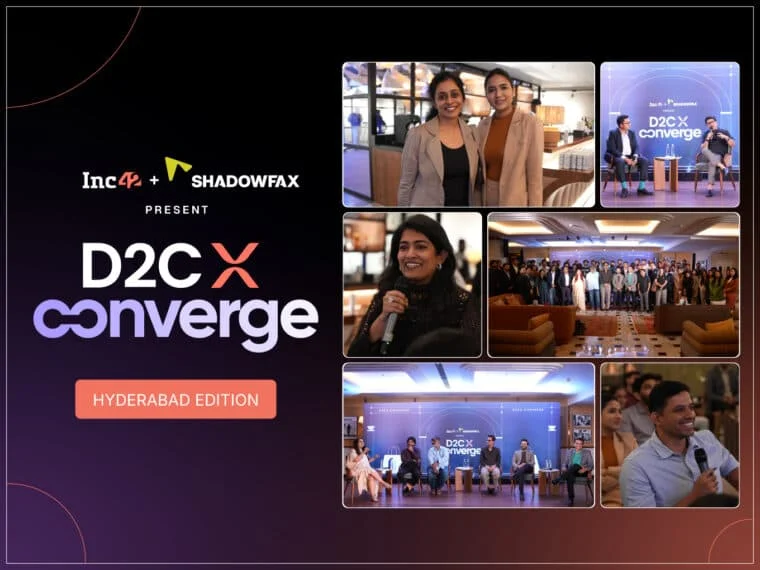
    Inc42 has teamed up with ShadowFaxShadowFax Datalabs_in-article-icon to support this next generation of consumer builders by launching D2CX Converge — a five-city founder meetup series designed to bring together India’s most promising early-stage D2C brands in an intimate and high-trust environment. The event is intended for builders who believe progress compounds in the community. Each stop gathers a curated room of early-stage D2C founders for compact, practical sessions led by successful operators. 

    A look at India’s D2C landscape shows Hyderabad emerging as a strong base for early-stage brands, supported by cost advantages, expanding digital infrastructure and a growing startup ecosystem. These factors made it a natural choice for Inc42 and Shadowfax to kick off the first chapter of D2CX Converge.

    On November 13, more than 50 D2C brand founders across categories, including beverages, fashion, FMCG, ethnic wear, consumer retail, and lifestyle, converged on Hyderabad. There was clarity in the shared goal: Gather India’s most promising early stage operators in a city where momentum is palpable, ambition runs high, and the environment catalyses founders to test, refine, and scale their playbooks.

    The evening featured a sessions, which brought together diverse perspectives from across the D2C landscape.

    The D2C galaxy at the event included the likes of:

    • Nikhil Doda, cofounder and COO of Lahori Zeera
    • Srishti Tanwani, cofounder and CEO of Indo Era
    • Raju Bhupati, founder and CEO of Troo Good
    • Praharsh Chandra, cofounder and CBO  at Shadowfax
    • Shashi Kumar, cofounder and CEO of Akshayakalpa Organic
    • Rahul Dayama, founding partner at Urbanic
    • Avnish Kumar, managing director at NEERU’S
    • Karan Saraf, director of deals at PwC

    Using Insight To Drive Mass-Market Growth

    The fireside chat, themed ‘How Lahori Zeera Cracked India’s Mass Beverage Market’, featured Doda outlining how the brand identified unmet demand for familiar, desi flavours and built a scalable product around it. He discussed creating the INR 10 price point, shaping a distinct brand identity without celebrity marketing, and focusing on consistent execution — from taste to bottling partnerships — to compete in a crowded beverages category.

    “Ethnic Indian drinks always existed in homes, in unorganised formats. What we realised early was that the category lacked freshness. The Indian beverage market is an INR 80,000 Cr industry, and our aim was simply to do justice to a product the masses loved and make it aspirational,” Doda said. 

    A major part of the discussion centred on distribution, where he stressed how Lahori Zeera went against the trend and built its foundation through general trade. With no initial brand pull, the team took bottles directly to retailers, manually placed the product, and let repeat demand speak for itself. Distributors who originally declined returned after witnessing traction on the ground, allowing the company to scale without offering credit – an unusual feat in the beverages space.

    He also shared his views on how rising attention from large corporates and legacy beverage players was driving the overall market rather than threatening smaller innovators.

    India’s Next Wave Of Consumer Brands

    The panel discussion on the ‘D2C Brands’ INR 100 Cr Playbook’ went beyond surface-level growth tactics, diving into how brands must build emotional and operational moats to stay distinct and turn repeat cohorts into their strongest growth engine. The speakers also reflected on navigating seasonality, evolving consumer behaviour, and balancing product, pricing, and inventory complexity, offering the founders a rare inside view of the real decisions that pave the way to a revenue of INR 100 Cr and beyond.

    Several founders showed that it is possible to reach INR 100 Cr without burning marketing dollars, provided the product resonates, and the platform algos reward it.

    Tanwani of Indo Era explained how the brand built an INR 500 Cr business primarily through marketplaces without marketing spend. “We built our first INR 100 Cr without spending a rupee on marketing. The product did the work, and marketplaces gave us the traffic to prove ourselves,” she said. 

    Dayama shared insight into how a sharply defined influencer strategy helped Urbanic scale at an unprecedented pace. “We treated influencer marketing like a science – 11% of our GMV is directly traceable to creators because we score and track every collaboration.”

    The discussion reflected the diverse paths founders took to reach the INR 100 Cr milestone – marketplace-first, D2C-first, and offline-first. Yet, the consensus was clear: India in 2025 demands an omnichannel presence, but the sequencing depends on category dynamics and founder capability.

    As a legacy ethnicwear brand, NEERU’S  Avnish explained the challenges of shifting from pure offline to an omnichannel model. “Offline taught us scale, but online taught us speed. Omnichannel isn’t a strategy anymore, it’s simply where the customer expects you to be.”

    When the conversation shifted to Akshayakalpa Organic, Shashi explained why subscription was not dead yet, particularly in habitual-consumption categories like milk. “People say subscription is dead, but it powers 40% of our revenue — when a product enters daily life, retention becomes almost automatic,” he said. 

    The discussion then touched on a key challenge – how founders often feel pressured to broaden their catalogues early. The leaders reiterated that focus, and not breadth, drives the momentum. Whether beverages, fashion or food, SKUs have been central to unlocking scale.

    “We sell one thing and one thing only – chikki. When the product is perfect, the market expands on its own,” said Bhupati of Troo Good. 

    The Hyderabad edition of D2CX Converge showed exactly what it was designed for: unfiltered learnings, founder-to-founder candour, and practical playbooks that are applicable. 

    In 2026, D2CX Converge will travel to Mumbai, Jaipur, Ahmedabad, and Bengaluru and will bring together D2C and retail brands who are building meaningful traction in their categories.

  • Mswipe Gets Payment Aggregator Licence For Online & Offline Payments

    Mswipe Gets Payment Aggregator Licence For Online & Offline Payments

    Mumbai-based fintech startup MswipeMswipe Datalabs_in-article-icon Technologies has received the final payment aggregator (PA) licence from the Reserve Bank of India (RBI) for both online and physical payment modes.

    The licence allows the startup to aggregate different payment instruments for merchants, both online and offline. Mswipe can now onboard merchants and process customer payments across websites, mobile apps and physical stores under a single regulatory framework. 

    The approval comes more than two years after Mswipe received an in-principle nod from the RBI in August 2022. After the initial approval, the startup said it planned to build an in-house online payment gateway and move towards offering full-stack payment services to merchants operating across channels.

    The licence will also allow Mswipe to facilitate inward and outward cross-border payments, expanding its payments business beyond domestic transactions.

    Founded in 2011 by Manish Patel, Mswipe began as a point-of-sale (PoS) device provider focused on offline card payments. 

    Over the years, it has expanded its offerings to include PoS terminals with integrated online and offline card payments, QR codes, sound-based payment confirmation devices and payment gateways.

    In February 2024, the startup raised $20 Mn from Alpha Wave Ventures. The round included both equity and debt, with Alpha Wave also extending debt funding to the company through compulsorily convertible debentures.

    At the time, Mswipe said it would use the capital to expand its merchant payment network, strengthen product development and invest further in its technology infrastructure. 

    Overall, it has raised more than $118 Mn in funding from the likes of Alpha Wave Global, B Capital, Matrix Partners, DSG Consumer Partners, Epiq Capital, among others. 

    On the financial front, Mswipe’s payments business turned adjusted profitable in FY24. The startup reported a revenue of over INR 276 Cr for the year, while its net loss reduced 5.7% to INR 46.2 Cr. It is yet to file its FY25 numbers. 

    Mswipe competes with the likes of PhonePe, Paytm, Ezetap and Innoviti in India’s digital payments and merchant services space.

    The licence comes at a time when the central bank has given PA licence to a number of fintech companies recently, including Paytm, Unlimit, Airpay, Easebuzz, among others.

  • Kriti Sanon Invests In D2C Supplement Brand Supply6

    Kriti Sanon Invests In D2C Supplement Brand Supply6

    D2C nutrition and wellness startup Supply6 has roped in Bollywood actor Kriti Sanon as an investor and brand ambassador. 

    In a statement, the Bengaluru-based startup said it aims to deepen its engagement with urban, health-conscious consumers with the partnership by shifting the wellness conversation towards foundational habits such as effective hydration, balanced nutrition and long-term consistency.

    Founded in 2019 by Vaibhav Bhandari and Rahul Jacob, Supply6’s products aim to fill in the nutrient gaps in Indian diets. Its flagship product, Supply6 360, is a sachet intended for daily consumption that combines vitamins, minerals, probiotics and superfoods. It also sells a zero-sugar electrolyte mix and protein wafers. 

    These three products bring in INR 36 Cr in annual revenue, with a 45% repeat purchase rate, Zeropearl VC founder and managing partner Bipin Shah said in a LinkedIn post. Supply6 started by selling its products in India and now has a presence in the US as well, he added.

    It sells the products via its own website, ecommerce marketplaces like Amazon, and quick commerce platforms like Blinkit.

    In September, Supply6 raised $1.1 Mn (about INR 9 Cr) in its pre-seed funding round from Zeropearl VC, CRED founder Kunal Shah, and Renee Cosmetics cofounders Ashutosh Valani and Priyank Shah, and XYXX founder Yogesh Kabra. 

    Last year, the startup also roped in former South African cricketer AB de Villiers as an investor and brand ambassador.

    Supply6 operates in India’s dietary supplements market, which is projected to reach a size of $62 Bn by 2033, clocking a CAGR of 13% since 2024, according to IMARC Group. Many startups like OZiva, MuscleBlaze, Beastlife, among others, are looking to leverage this opportunity. 

    The development comes at a time when celebrities are increasingly partnering with new-age tech startups, not only to endorse their products but also to back them as investors at an early stage. 

    In 2023, Sanon partnered PEP Technologies, the parent of MCaffeine, to launch premium skincare brand ‘Hyphen’. Prior to that, she cofounded fitness brand ‘The Tribe’ with Anushka Nandani, Karan Sawhney and Robin Behl.